Showing posts with label Croatia. Show all posts

Friday, 2 December 2011

A rare sunset


For some reason we haven’t really had many great sunsets on our journey so far. Maybe it’s been the time of year, or maybe we just haven’t been in the right place at the right time.

Anyway, on the drive from Dubrovnik back to Split to catch the ferry to Italy, we got a beauty. It turned the whole ocean and all the mountains pink – a nice way to finish up in Croatia.

As a very brief closing comment on Croatia, it has been a fantastic and thoroughly worthwhile experience. The country is wonderfully diverse, authentic, and is stunningly beautiful. It has been quite eye opening to see so many living reminders of the long-term impact that war has on local communities.

Five stars.  

Twilight - A truly cultural experience


Yes, that’s right folks, Twilight: Breaking Dawn.

It was quite by chance that we stumbled across a cinema on Saturday night in Dubrovnik that was showing the film, released just a few days earlier. Monique begged Daniel, and being the good husband that he is, decided that he would graciously accompany her to see the film. For the equivalent of AUD$4.5, it was hard to say no.

We took our seats and soon realized that if somebody was to graph the ages of everyone in the cinema, we would be statistically significant outliers. It was us and every 13-year-old from the west coast of Croatia.

And boy were they excited.

When the film started it was like being at the opening bounce of the AFL Grand Final. An almighty, high-pitched scream of excitement filled the cinema, and was then followed by loud, pre-pubescent chatter, giggling and discussion for the next two hours. Being an English film with Croatian subtitles, it seemed that the locals were quite content to read along, and were not too concerned with the two aging Australians who had no idea what going on.

This was indeed a truly cultural experience. Forget about the opera in Salzburg, a cinema full of screaming 13 year olds in Dubrovnik is as good as it gets. 


Oh, and as for the video, turn your speakers up and repeat for two hours. 

Thursday, 1 December 2011

Dubrovnik


From Hvar we caught the ferry back to the mainland of Croatia and continued heading south to Dubrovnik. There were no campsites open which would have been annoying but for Monique finding a guesthouse that was cheaper than most campsites that we’ve been staying in. A huge win for us.

Feeling well rested and rejuvenated after putting our feet up in Hvar, we hit Dubrovnik with much enthusiasm. It would be hard not to. Dubrovnik is an amazing city – it’s marbled streets, terracotta roofs, narrow laneways and stunning city wall overlooking the Adriatic are immediately captivating.

Highlights for us included a boat trip around the wall and the outer island, gelati, walking the city wall, and Twilight…

Island paradise - Hvar


From Split we headed south and took a short ferry ride across to the island paradise Hvar. Sitting just off the coast of Croatia, Hvar has been voted as being in the most beautiful islands in the world. We haven’t been to too many islands other than Hvar, but it is hard to imagine too many beating it.

The main town sits on a hill overlooking the small boat-filled harbor with the most perfectly crystal clear water imaginable. The town is flanked by a series of smaller islands that form a gorgeous backdrop.   

With no campsites being open on the island we indulged in a guesthouse with a terrific view. We spent the bulk of our time on the island enjoying the sun, eating long lunches, taking long walks, and reading on the promenade. Happy days. 

Diocletian's Palace


With the magnificent Croatian sun still shining we explored Split’s city centre - also known as Diocletian’s Palace.

The Roman Emperor Diocletian built the palace in preparation for his retirement in 305AD. After the Romans abandoned the site, the Palace remained empty for a few hundred years. In the 7th century local villagers fled to the palace to avoid the invading barbarians. Ever since, they have made themselves rather comfortable, making their homes and businesses within the palace basement and directly in its walls.

It has been preserved remarkably well, and now it is the historical old town of Split. It was quite bizarre thinking that what was once the epitome of Roman luxury is now filled with fast food outlets and cafĂ©’s.

It is so beautiful, that not for the first time, we shook our head in amazement and wondered ‘do people actually live here?’ 

Thursday, 24 November 2011

Salona


We kicked things off in The Adriatic by gleefully tucking our thermals, beanies, gloves and fleeces away in the depths of the van.

Breakfast consisted of dusting off the camping chairs and enjoying our bowl of cornflakes by the water in the radiant morning sun.

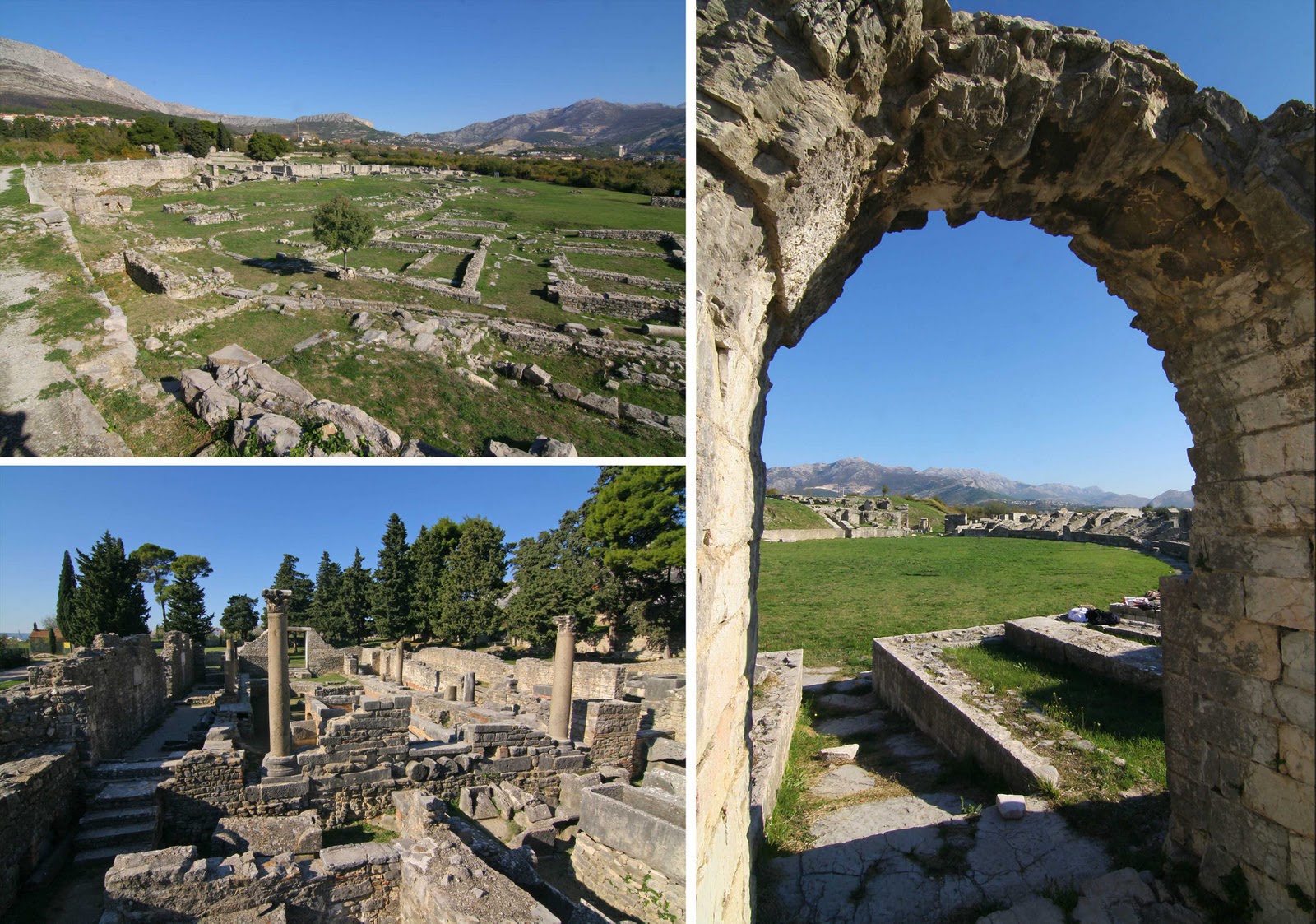
Feeling alive, we set of to see the ruins of the ancient city Salona. Once a thriving city, it was destroyed by the Romans in 614AD. Now, the ruins sit in amongst the suburbs of Split. It was bizarre yet wonderful to watch local families out on a Sunday afternoon kicking a soccer ball around the ruins of a 1500-year-old amphitheatre.  

Monday, 21 November 2011

A day of two extremes Part 2 – The Adriatic


As we continued south towards Split from the Plitvice Lakes it was remarkable how quickly the landscape changed. The area surrounding the Plitvice Lakes was quite lush, green and forested, but it wasn’t long before the terrain changed to being dry, harsh and arid. For the South Africans out there, Monique described it as being quite ‘Pilanesberg-esque’.

As we kept heading south we made our way over a mountain range and as we came over the top we soon saw the magnificent sparkling blue waters of the Adriatic. It was a magnificent sight. Equally as magnificent was watching the thermometer on the car. It wasn’t long before we saw it hit a very balmy 17 degrees.

We stopped off at the coastal town of Sibenik to watch the sunset (which is now happening at about 4:30pm each day) before continuing on to Split. We were right in the middle of a classically Dalmatian town – stone houses with terracotta roofs situated on a hillside in a bay overlooking the ocean.

We had to pinch ourselves. It is almost hard to image such a diverse day.

A day of two extremes Part 1 –the Plitvice Lakes


We kicked things off in Croatia by visiting the UNESCO protected Plitvice Lakes. There were no campsites open in the area so we booked a guesthouse. It was a good thing that we did because it was a particularly cold night.

We arrived at the Lakes at 9am and the car was telling us that it was 0.5 degrees, but we think it was exaggerating. It was proper cold. We employed our full warmth strategy of thermals, fleece, jackets, beanies, scarves and gloves and we were still freezing.

Not to be deterred, we set off to see the lakes. The best way of describing them is to imagine a massive champagne waterfall. Essentially, the area is a series of 16 lakes, each creating a plateau that creates a waterfall down to the next lake which then plateaus before creating a waterfall down to the next lake, and so on and so on. There were literally thousands of waterfalls ranging in size and intensity from small little trickles dropping over stones, to a raging 100-meter torrents. It was an amazing sensory experience with birds chirping, schools of fish swimming in the crystal clear water and the constant noise of the water skipping over rocks. The place felt alive.

It was one of the most incredible natural wonders that we have ever seen. It’s magnificence is hard to describe, and it’s scale hard to capture in photos.

Almost frozen, we finished up at about 1pm and began our drive south to our next stop, Split. We hadn’t gone far when we saw that the trees in the forest had started to freeze which created a beautiful white canopy over the forest.

Saturday, 19 November 2011

Driving through a war zone


We arrived in Croatia and as we drove east through the northern part of the country we were shocked to see an enormous amount of abandoned villages and houses. We’re not talking about the amazing ancient stone ruins that we saw in Ireland, rather entire towns lying abandoned, dilapidated and in ruin.

As we drove on, we soon realized that this was not an isolated pocket, but a trend that spanned literally hundreds of kilometers. Even where there were signs of life, occupied houses were still dotted amongst the ruins.

As we looked closer, we soon saw that many of the abandoned houses had bullet holes sprayed on their decaying walls, often focused around the windows.

It soon occurred to us that these once rural farming villages that we were driving through had in fact been the frontline of the Croatian War during the early-1990s. It was chilling to get a glimpse into the tragic reality that civilians are usually the first and worst impacted by war, and an insight into the long term impact that this has on local communities.